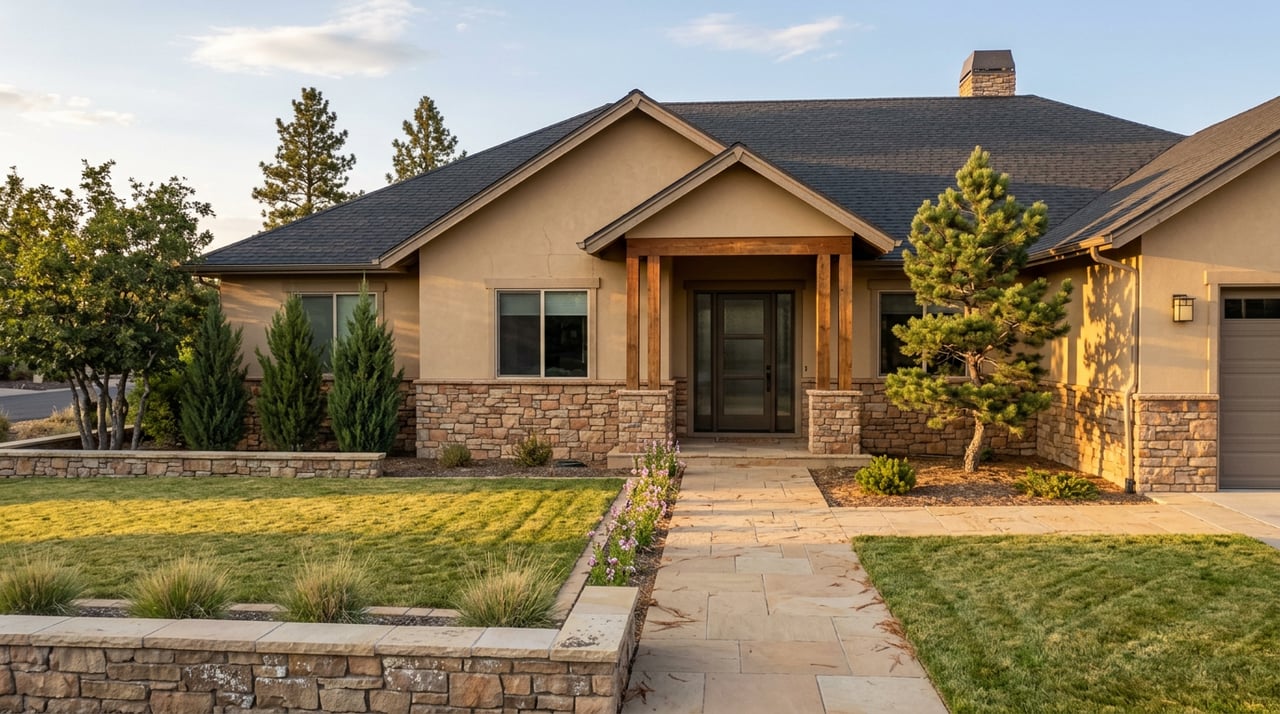
Same Address, Different Tax Bill: What Flying Horse's Metro Districts Actually Cost You
September 10, 2026
September 10, 2026
Pull up two Flying Horse listings with the same square footage, the same builder finish package, and a five-minute walk to the clubhouse at The Club at Flying Horse. The list prices are close enough to round to the same number. The property tax line on each one is not. One buyer's title company quotes a bill several hundred dollars higher than the other's, on homes that look identical on paper. Neither number is a mistake. The difference is which of three metropolitan districts that specific lot happens to sit inside.
This is the piece of Flying Horse ownership that a median sale price cannot tell you, and it is the piece worth understanding before you write an offer, not after you close.
Flying Horse is built and governed as a master-planned community of roughly 1,975 homes, organized under three separate metropolitan districts: Flying Horse Metropolitan District No. 1, No. 2, and No. 3. District 1 handles management and administration for all three. District 2 covers most of the residential parcels. District 3 covers the commercial ground, including the areas around the club and the retail nodes along Colorado 83.
Here is the number that changes the math for a buyer comparing Flying Horse to almost anywhere else in the northern Colorado Springs suburbs: The Gazette reports that the metro districts collect roughly 40 percent of what a Flying Horse homeowner pays in property tax. That money is not county tax, city tax, or school district tax. It is a separate mill levy layered on top of those, and it exists to pay down bond debt the developer, Classic Homes, took on to build the roads, sidewalks, water lines, and sewer lines when the neighborhood was platted.
That distinction matters because a metro district is not a homeowners association. An HOA collects dues for landscaping and covenant enforcement. According to Flying Horse Metropolitan District No. 1, a metro district is a unit of local government with the legal authority to levy property tax and issue bonded debt, the same tool a city or fire district uses, just narrower in scope and, in Flying Horse's case, formed the same year the neighborhood broke ground in 2004.
Because District 2 and District 3 carry separate debt loads and separate levy schedules, the actual mill rate a homeowner pays depends on which district their parcel falls in, not just on the county's base rate. El Paso County's mill-levy table shows District 2's residential levy running in the mid-40s to just under 50 mills in recent years, while District 3's has tracked in a similar range for its commercial-facing parcels. District 1, which handles administration rather than direct debt service, carries a much smaller levy by comparison, closer to 10 mills in its most recent transparency notice.
None of those figures are static. They move with the county's assessed valuation and with whatever debt service schedule the district board approves each budget cycle, most recently the 2026 budget District 1's board took up at a November 2025 meeting. A listing sheet or comp report may not show these district-specific details. The only way to know the real number for a specific address is to ask the listing agent or title company which district the parcel sits in and pull that district's current mill levy directly.
The districts' finances and governance have also been shaped by board changes, litigation, and a 2024 settlement.
From 2004 until May 2023, Classic Homes executives sat on all three district boards. That May, residents Gary Helfeldt, Bill Graziano, and Mike Guyote won a slate election for District 2 and 3 seats, unseating Classic Homes representatives George Lenz, Douglas Stimple, and Joseph Loidolt. The Gazette reported that it was the first time since the districts were created that homeowners, rather than the builder, controlled the boards responsible for roughly $58 million in District 2 debt at the time.
The election did not transfer all financial authority. The Gazette reported that under the intergovernmental agreement governing all three districts, Classic Homes-controlled District 1 retained the right to spend on behalf of Districts 2 and 3, and residents were not eligible to run for District 1's board at all. By August 2023, District 1 sued the newly resident-led boards, asking a court to place Districts 2 and 3 into receivership over a dispute about unpaid operation and maintenance funds. The resident boards countered that they had remitted every dollar budgeted for the year.
That November, voters in Districts 2 and 3 also passed ballot measures rolling back the districts' unused bonding authority, cutting District 2's potential debt ceiling from $61.3 million to $3.7 million and District 3's from $94.5 million to $1.14 million, and requiring voter approval before the boards could enter multiyear contracts again.
The lawsuit and the underlying disagreement over roughly $17 million in disputed debt claims took until September 2024 to reach a mediated settlement, and November 2024 for voters to approve the terms set out in El Paso County's 2024 ballot language: a 15-year schedule of annual payments equal to 3 mills, directed to District 1, starting at about $305,000 in year one; official election returns confirm voters approved the measures. As part of that settlement, control over the land planned for Downtown Flying Horse, the neighborhood's still-developing commercial district near New Life Drive and Colorado 83, moved to District 1.
Dan Mulloy, one of the resident board members who pushed for the settlement, put the goal plainly during the fight, as reported by the Gazette: "The ultimate goal is to gain control over our tax revenues." Bill Graziano, who had run on the same slate, described the challenges ahead in the Gazette's reporting: "We are in for a tough fight."
For a buyer weighing Flying Horse against another Front Range suburb on the strength of a median price alone, the metro district structure is the variable that median can't show you. Two homes priced identically can carry a meaningfully different annual tax bill depending on district, and district rates may reflect debt service and settlement terms rather than a fixed rate anyone can assume will hold.
That is not a reason to avoid Flying Horse. It is a reason to ask a more specific question than "what's the tax rate here." Ask which district the parcel sits in, ask for that district's current mill levy from its own transparency filing rather than a rounded estimate, and factor the 2024 settlement's 15-year payment schedule into how you think about long-term carrying cost.
If you're comparing Flying Horse to a neighborhood built without a metro district structure, the comparison isn't apples to apples on tax burden even when the sale prices match. That's worth raising with your lender when you're running numbers on a monthly payment, not after the first tax bill arrives.
Is a metro district the same thing as the HOA? No. The metro districts are units of local government with the authority to levy property tax and issue bonded debt. Flying Horse's HOA structure, which handles covenant enforcement and community standards, is separate from the metro districts and their finances.
Can the mill levy go up after I buy? It can move with the county's assessed valuation and with whatever budget the district board approves each year, including the debt service schedule set by the 2024 settlement. The specific figure for a given parcel should be confirmed with the district or title company at the time of purchase rather than assumed from a prior year's rate.
Does the 2024 settlement mean the disputes are fully resolved? The settlement resolved the litigation between the districts and set a defined 15-year payment schedule. The boards remain separately governed and continue to hold regular meetings and annual budget votes, most recently the November 2025 session that set the 2026 budget, so it is worth checking current district communications rather than treating 2024 as the final word.
If you're weighing Flying Horse against another northern Colorado Springs neighborhood and want the real carrying cost for a specific address, not just the county's base rate, The Fletcher Team & Associates can pull the district-specific numbers before you write an offer. Receive Exclusive Listings & Free Home Valuation.
This article is general information, not legal, tax or financial advice. Consult a qualified professional about your situation.

A Confident Buyer's Guide to Roof and Foundation Health in Monument, Colorado, Real Estate.

Designing a Productive Workspace That Matches the Way You Live in Monument, CO.

A Local’s Guide to Leafing Trails and Spots Near Monument.

A Map to the Trails Locals Love Hiking Near Monument.

Staging Tips That Turn Pikes Peak Views Into Offers for Your Monument Home.
Having the right real estate team means having a team who are committed to helping you buy or sell your home with the highest level of expertise in your local market. This means also to help you in understanding each step of the buying or selling process.
Get In Touch With Our Team
155 2nd Street Monument, CO 80132